Ski mountaineering made its Winter Olympic debut at Milano Cortina 2026, introducing a competition that combines uphill skiing, climbing on foot with skis strapped to a backpack, and technical descents. Known internationally as SkiMo, the sport brought three medal events to the Stelvio Ski Centre in Bormio on February 19 and 21. With 36 athletes competing across men’s and women’s sprints and a mixed relay, the debut offered a concentrated demonstration of endurance, speed, and equipment-handling skills.
Ski Mountaineering as a Competitive Discipline
Competitive ski mountaineering developed from traditional ski touring, where participants travel across mountainous terrain using specialized equipment for ascending and descending slopes. Unlike alpine skiing, where athletes generally begin at the top of a course, ski mountaineers must climb under their own power before racing downhill. The discipline combines aerobic endurance with balance, technical skiing, and the ability to change equipment configurations quickly.
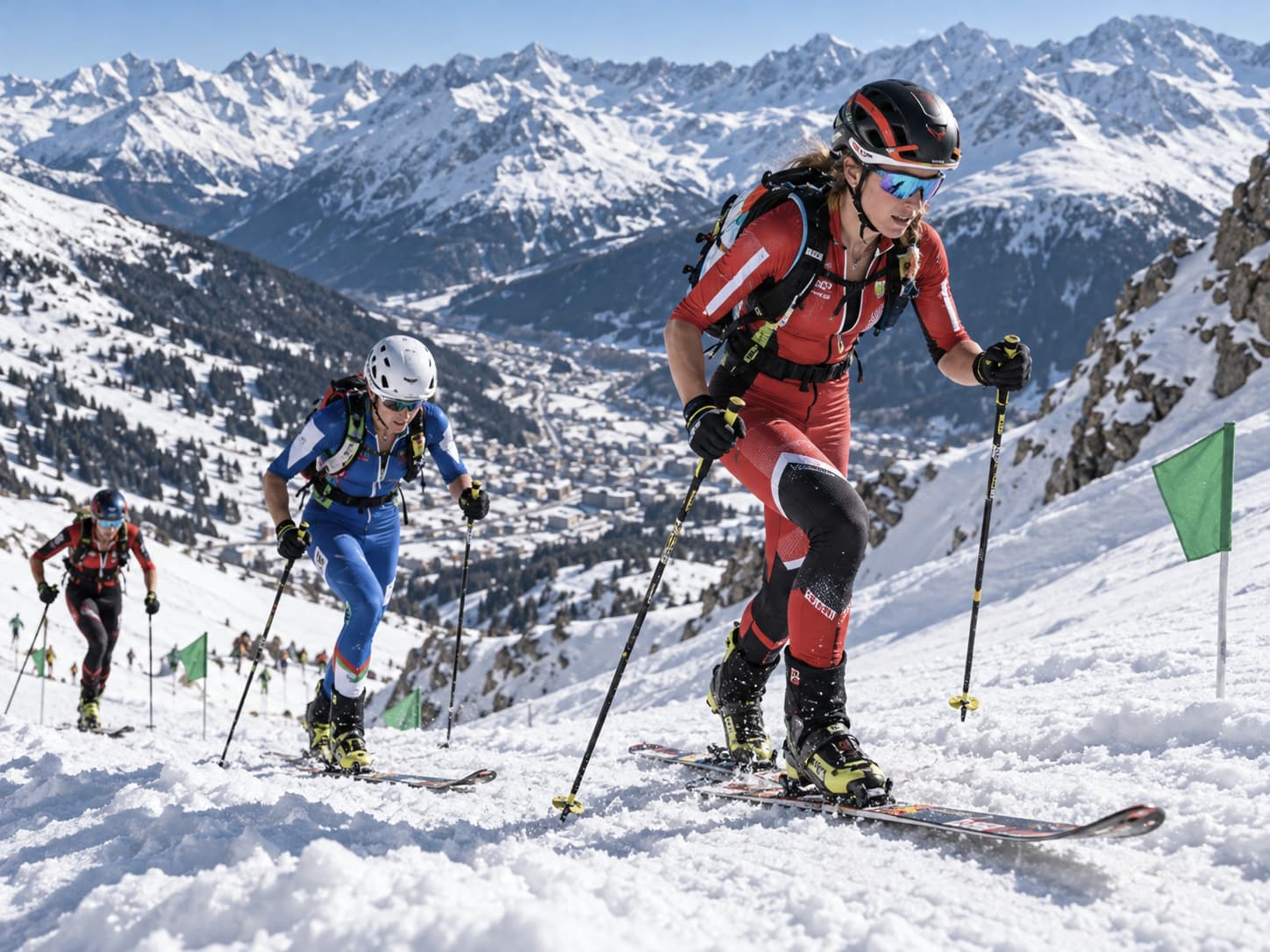
During uphill sections, athletes attach climbing skins to the underside of their skis. These strips provide traction, allowing forward movement while reducing backward slipping. On particularly steep sections, competitors remove their skis and secure them to their backpacks before climbing on foot. Once they reach the descent, they remove the skins, adjust their bindings and boots, and prepare for downhill skiing.
These transitions are a defining feature of competitive SkiMo. Removing equipment too slowly can erase an advantage gained during a climb, while a poorly secured ski or skin can cause further delays. Elite athletes therefore spend considerable training time practicing transitions until they can complete them quickly and accurately under physical exhaustion.
The sport had already appeared at the Lausanne 2020 Winter Youth Olympic Games. Its inclusion in the senior Winter Olympics was approved by the International Olympic Committee in July 2021, following years of international competition organized under the International Ski Mountaineering Federation. For the 2026 debut, the final program focused on shorter, spectator-friendly formats rather than traditional long-distance mountain races.
Bormio and the Olympic Competition Courses
The Stelvio Ski Centre in Bormio, northern Italy, hosted the inaugural Olympic events. The mountain venue was also used for men’s alpine skiing competitions, allowing organizers to incorporate SkiMo into existing Olympic infrastructure. Its steep terrain provided space for climbing sections, technical transitions, and fast descents within a relatively compact competition area.
The Olympic sprint course measured approximately 725 meters, beginning at an altitude of 1,200 meters and featuring 65 meters of elevation gain. Although relatively short, the route included several distinct sections requiring different movement techniques. Athletes climbed with skins attached, carried skis through a steep section, resumed climbing, and finally descended toward the finish.
The mixed relay used a longer circuit of approximately 1,410 meters with 137 meters of climbing and descent per lap. Its route demanded repeated transitions and coordinated exchanges between teammates. The compact layout also made the competition easier to follow than traditional mountain races extending across several kilometers of remote alpine terrain.
Weather added an unexpected challenge to the debut. Heavy snowfall affected the February 19 sprint competitions, reducing visibility and making some sections more difficult to negotiate. Athletes had to maintain balance and execute equipment changes precisely despite rapidly accumulating snow and intense physical effort.
The Olympic Sprint and Its First Champions
The men’s and women’s sprint competitions took place on February 19, with 18 athletes participating in each event. Competitors raced in groups of six, beginning with preliminary heats before advancing through semifinals to the final. The three leading athletes from each opening heat qualified automatically, along with the three fastest remaining competitors. Six athletes eventually reached each medal race.
A single sprint typically lasts between two and three minutes, making the event exceptionally demanding. Competitors must accelerate immediately, maintain a high climbing intensity, negotiate the on-foot section, and perform equipment changes without wasting valuable seconds. Unlike longer endurance races, the format offers little opportunity to recover from mistakes.
Switzerland’s Marianne Fatton became the first Olympic ski mountaineering champion by winning the women’s sprint in 2 minutes 59.77 seconds. France’s Emily Harrop, one of the leading athletes entering the competition, finished second in 3:02.15, while Spain’s Ana Alonso Rodriguez secured bronze. Fatton finished 2.38 seconds ahead of Harrop, a clear margin in a race lasting barely three minutes.
Spain’s Oriol Cardona Coll won the men’s sprint in 2:34.03, securing the country’s first Winter Olympic gold medal in 54 years. Nikita Filippov, competing as an Individual Neutral Athlete, claimed silver, while France’s Thibault Anselmet finished third. Cardona’s victory combined explosive climbing speed with efficient movement through the technical sections.
Mixed Relay and Team Strategy
The mixed relay concluded the Olympic SkiMo program on February 21. Twelve teams competed, each consisting of one woman and one man. Every athlete completed two laps in the fixed sequence of woman, man, woman, man, with teammates alternating throughout the race.
Each relay exchange required the finishing athlete to enter a designated handover zone and make physical contact with the next competitor. Both athletes’ skis had to be inside the zone for a legal exchange. These rules made coordination important, particularly when athletes arrived at high speed after completing a demanding descent.
The relay combined individual physical performance with tactical decisions. Teams needed both athletes to maintain consistent speeds, execute transitions cleanly, and avoid penalties. A mistake early in the race could create a gap that the second athlete would struggle to close, while a strong final lap could reverse positions near the finish.
France’s Emily Harrop and Thibault Anselmet won the first Olympic mixed relay title in 26:57.44. Switzerland’s Marianne Fatton and Jon Kistler finished second, 11.86 seconds behind, while Spain’s Ana Alonso and Oriol Cardona took bronze despite receiving a three-second penalty. The French victory gave both athletes another Olympic medal after their individual sprint performances.
The event demonstrated a different competitive dimension from the individual sprints. Instead of relying on one explosive performance, athletes had to manage repeated efforts while coordinating with a teammate. Rapid equipment handling remained essential, but consistency across four laps became equally important.
The Olympic Future of Ski Mountaineering
The Milano Cortina debut marked an important step for a sport traditionally associated with alpine communities and mountain endurance competitions. Spain, Switzerland, and France won the three inaugural gold medals, reflecting the strength of established European SkiMo programs. However, athletes from more than a dozen nations participated across the Olympic events, demonstrating a competitive field extending beyond the sport’s traditional centers.
The 2026 program also raised questions about how Olympic competition should represent the broader discipline. Sprint racing emphasizes explosive power and rapid transitions, while traditional individual ski mountaineering involves much longer climbs, descents, and sustained endurance. Both formats demand technical skill, but they test athletes in substantially different ways.
On June 25, 2026, the International Olympic Committee approved ski mountaineering’s inclusion in the French Alps 2030 Winter Olympics. The program is expected to expand to five medal events, adding men’s and women’s individual races alongside the existing sprints and mixed relay, although the final event list still has to be confirmed. If approved, this change will allow athletes specializing in longer mountain courses to compete for Olympic titles.
The first Olympic appearance established SkiMo as a distinctive combination of endurance sport and technical mountain competition. Its success in Bormio showed that short races could deliver competitive intensity while preserving the discipline’s essential elements of climbing, equipment transitions, and descending. With individual events expected to join the program in 2030, future Games will provide a broader representation of what ski mountaineering demands from elite athletes.