HYROX has transformed functional fitness from a gym-based activity into an international competitive sport. Its standardized format combines eight kilometers of running with eight workout stations, testing endurance, strength, and the ability to perform under fatigue. What began as a single event in Germany in 2017 has grown into a global racing series attracting professional athletes and recreational gym members.
The expansion has accelerated in 2026. According to organizers, more than 1.5 million athletes participated during the 2025/26 season, while over two million are expected across 107 race weekends in 2026/27. These figures reflect a growing interest in competitions that allow ordinary fitness enthusiasts to measure their performance against consistent international standards.
From a German Fitness Event to a Global Sport
HYROX was launched in Hamburg in 2017 by Christian Toetzke, Olympic field hockey medalist Moritz Fürste, and marketing specialist Michael Trautmann. Their concept was to create a repeatable competition that combined running with functional exercises familiar to gym members. Unlike events with constantly changing workout combinations, HYROX introduced a fixed race format that could be reproduced in different cities.
The early competitions attracted endurance athletes, functional fitness enthusiasts, and people seeking a goal beyond regular gym sessions. International expansion accelerated as organizers introduced races across Europe, North America, Asia, and other regions, supported by local gyms offering specialized preparation programs.
The attraction extends beyond elite competition, since separate divisions allow people with very different fitness backgrounds to take part in the same event.
Eight Running Segments and Eight Workout Stations
Every standard HYROX race follows the same sequence: a one-kilometer run followed by a functional workout station, repeated eight times. The eight-kilometer running distance remains unchanged across the main divisions, while the prescribed exercise loads differ according to category.
The workout stations appear in a fixed order:
- SkiErg – 1,000 meters on a ski-ergometer.
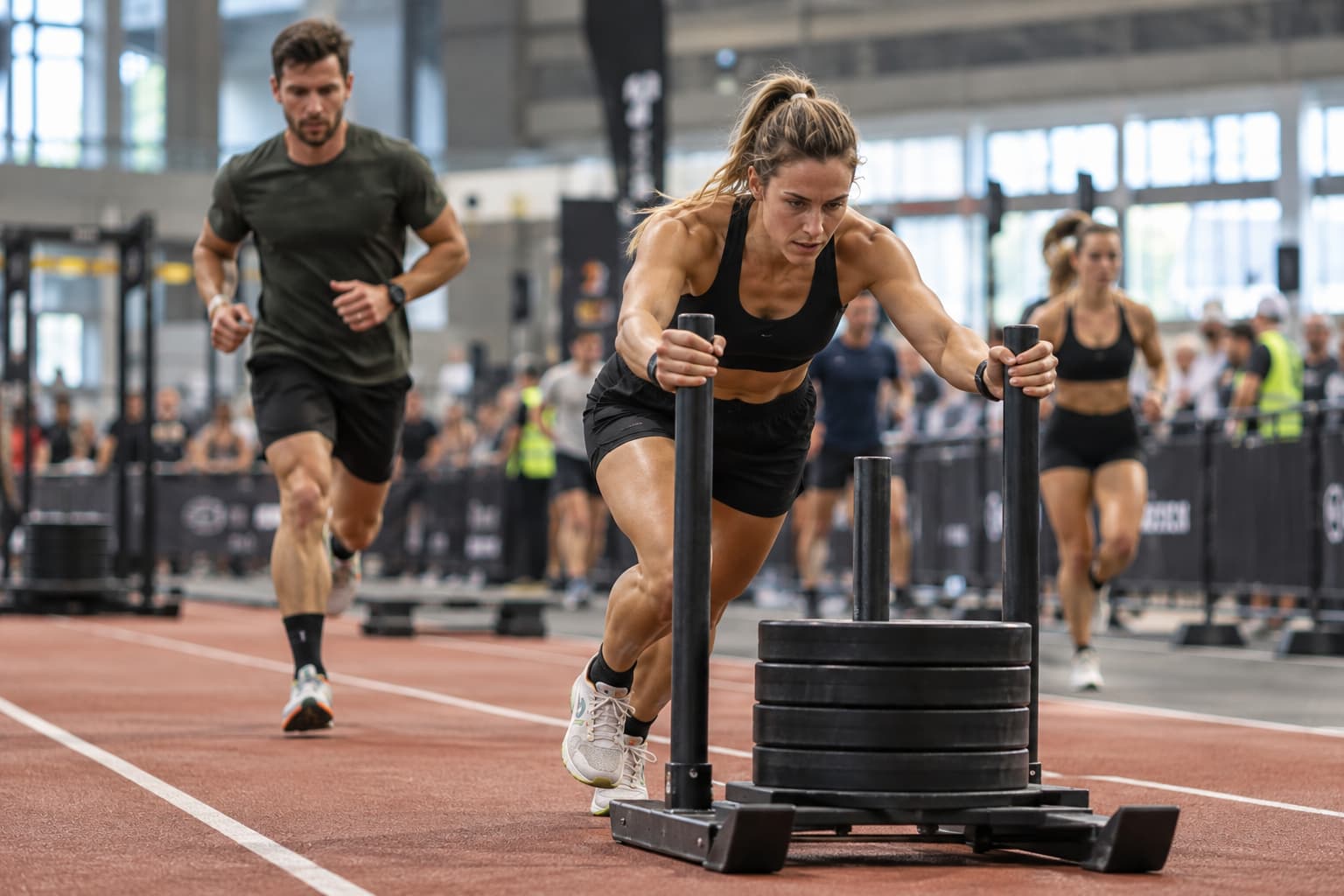
- Sled Push – pushing a weighted sled for 50 meters.
- Sled Pull – pulling a weighted sled for 50 meters.
- Burpee Broad Jumps – covering 80 meters with burpees and forward jumps.
- Rowing – 1,000 meters on a rowing machine.
- Farmers Carry – carrying two kettlebells for 200 meters.
- Sandbag Lunges – completing 100 meters of walking lunges.
- Wall Balls – performing 100 squat-and-throw repetitions with a weighted ball.
The stations test different physical qualities, but the challenge comes from completing them between repeated runs. Heavy sled work can fatigue the legs before the next kilometer, while rowing places additional demands on breathing and muscular endurance. By the final wall-ball station, athletes must maintain movement accuracy despite accumulated fatigue.
Competition divisions help accommodate different levels of preparation, and age-group rankings let participants compare themselves with people of similar age. Open categories use lighter prescribed loads than Pro divisions, while Doubles teams run together and share the work at exercise stations. Four-person relay teams divide the race into sections, with each member completing two running segments and two workouts.
Electronic timing records overall results and individual splits. Because the basic course structure remains consistent, athletes can compare performances between events and identify specific areas for improvement. Differences in venue conditions and equipment surfaces can still influence finishing times.
The Factors Behind the Fitness Racing Boom
One reason for HYROX’s popularity is that the competition offers a measurable objective. Traditional gym training can feel repetitive when progress is assessed only through body weight or individual lifting records. Preparing for a race introduces a clear deadline and combines running improvements with functional strength development.
The format also attracts athletes from different sporting backgrounds. Runners may already possess strong aerobic endurance but struggle with weighted sleds and lunges, while strength-trained participants can perform well at individual stations yet lose time during the running segments. The race rewards competitors who develop both qualities rather than specializing entirely in one.
Community participation has supported the expansion. Training clubs organize group sessions, fitness centers introduce race-specific classes, and friends enter Doubles or Relay divisions together. The shared preparation process turns an individual fitness challenge into a social activity, encouraging participants to return for subsequent events.
The commercial structure has expanded alongside participation. In February 2026, the National Strength and Conditioning Association announced a partnership with HYROX Academy to develop coaching standards. Additional partnerships with fitness equipment companies and group training providers have helped establish a broader training ecosystem around the competitions.
The 2026 World Championships in Stockholm
The growing professional side of fitness racing was evident at the HYROX World Championships, held at Strawberry Arena in Stockholm from June 18 to 21, 2026. The competition brought together leading international athletes across individual, doubles, and age-group categories, demonstrating the sport’s development beyond recreational participation.
Dylan Scott won the men’s Elite 15 individual title in 53 minutes and 47 seconds. Louis Osselaer finished second in 54:02, followed by Tim Wenisch in 54:04. The narrow separation between the leading finishers showed how a few seconds gained during running segments or workout transitions could influence the final rankings.
The women’s Elite 15 title went to Alyssa McElheny, who completed the course in 56:59. Joanna Wietrzyk finished second in 57:14, while Sinéad Bent took third in 57:24. McElheny’s 15-second margin over Wietrzyk was one of the clearest gaps among the leading finishers in either race.
Stockholm illustrated the increasing specialization of elite HYROX training. Successful athletes must combine efficient running technique, muscular endurance, pacing strategies, and consistent execution at every station. A competitor with exceptional running ability cannot rely on speed alone when substantial strength-based tasks account for a significant portion of the race.
Training Demands and the Future of Fitness Racing
HYROX preparation differs from training exclusively for a road race or strength competition. Athletes need sufficient aerobic capacity to complete eight kilometers of running while retaining the strength and coordination required for demanding functional movements. Training programs commonly combine running sessions, resistance exercises, station technique, and workouts that simulate movement between running and strength tasks.
Managing fatigue is especially important. Repeated heavy exercise can alter running mechanics, while insufficient recovery increases the likelihood of overuse problems. Beginners benefit from gradually increasing training volume and practicing unfamiliar movements before attempting competition loads. Appropriate preparation should reflect individual fitness levels rather than copying the schedules of elite racers.
The expanding event calendar creates opportunities for the sport to develop further. HYROX has announced new host cities, including San Diego, Portland, Bari, and Nagoya, for the 2026/27 season. Some established locations are moving beyond traditional one- or two-day events to competition periods lasting up to ten days to accommodate demand.
Fitness racing has also attracted attention from international sports organizations. World Triathlon has incorporated fitness racing into its broader development plans, while HYROX representatives have discussed ambitions for future Olympic recognition. Such recognition remains a long-term possibility rather than a confirmed Olympic commitment.
HYROX’s development demonstrates how a standardized physical challenge can connect recreational training with organized international competition. Its continued growth will depend on maintaining accessibility for newcomers while establishing credible coaching, judging, and competitive standards for professional athletes.